April 7, 2025
RERA for Real Estate Agents – What You Should Know
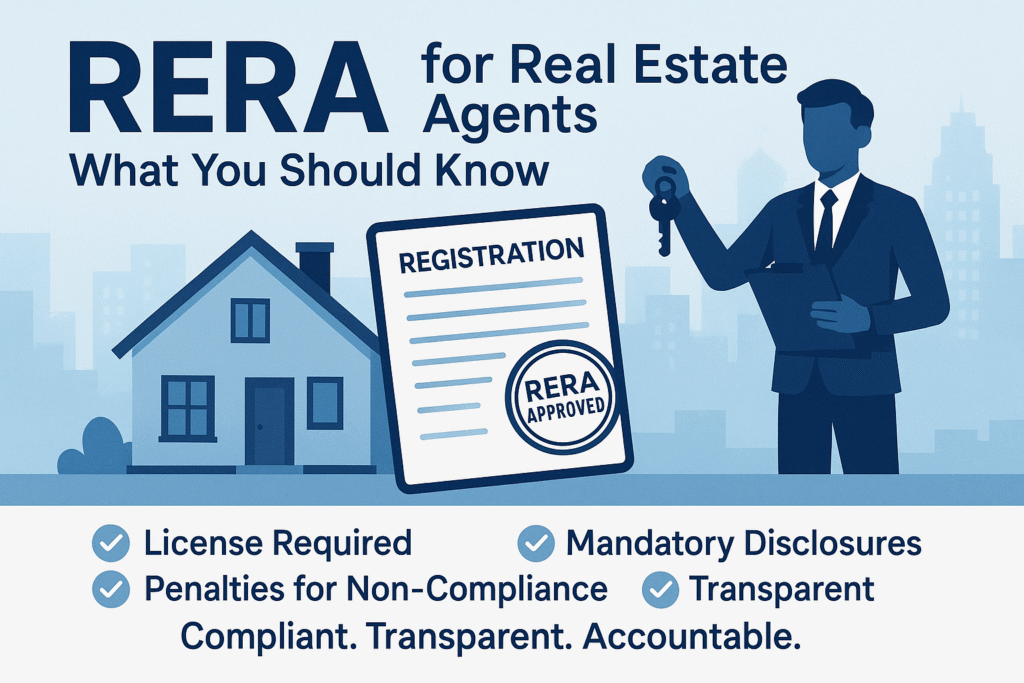
The Real Estate (Regulation and Development) Act, 2016, commonly known as RERA, is not only a protective framework for homebuyers but also a comprehensive regulatory structure for all stakeholders in the real estate industry—including real estate agents. While much of the focus of RERA has been on builders and developers, it is equally crucial to understand that property agents also fall under its purview. Prior to RERA, there was no formal regulation for property agents, which often led to misinformation, opaque dealings, and a lack of accountability. RERA seeks to change this by bringing transparency, professionalism, and legal responsibility to the role of real estate agents in property transactions.
Under Section 9 of RERA, every real estate agent who intends to facilitate the sale or purchase of any plot, apartment, or building in a project registered under RERA must themselves be registered with the respective State Real Estate Regulatory Authority. The registration process involves submitting necessary documents and a fee, as prescribed by the authority. Once registered, agents are issued a RERA Registration Number, which they must mention in all advertisements and during any real estate transaction. This legal recognition ensures that only compliant and verified individuals or firms are involved in property dealings, thereby safeguarding the interests of both buyers and sellers.
More specifically, Section 9(2) requires that the agent apply to the Authority in the prescribed manner. While procedures differ slightly across states, certain mandatory documents are generally required across all jurisdictions. These include:
(i) applicant’s details such as name, address, contact number, and photograph;
(ii) copy of the PAN card;
(iii) brief enterprise details like name, business address, and type of entity;
(iv) registration documents such as partnership deed, certificate of incorporation, bye-laws, MOA or AOA depending on the type of business;
(v) address proof of the business premises; and
(vi) a declaration that the applicant has not been convicted of any offence involving moral turpitude in the past five years.
Upon scrutiny, the authority may issue a registration certificate, usually valid for five years and subject to renewal.
Duties and Responsibilities under Section 10
Moreover, under Section 10, agents are required to comply with certain duties such as
· Dealing only in registered projects
- Providing accurate and verified project information
- Maintaining transaction records for at least 5 years
- Assisting buyers and sellers with rights, documentation, and project status
- Avoiding misrepresentation or misleading practices
Violation of these duties can result in penalties under Section 62, including a fine of ₹10,000 per day of default (up to 5% of the unit cost), or suspension/cancellation of registration.
Legal Recognition and Market Impact
Under Section 2(zm) of the Act, a “real estate agent” includes individuals, firms, societies, and companies involved in facilitating the sale or purchase of units in registered projects. This inclusion provides agents with formal legal identity and professional legitimacy.
A landmark judgment that reinforced this responsibility is “M/s. MK Enterprises v. MahaRERA” (2018), where the Maharashtra Authority held an agent liable for misrepresenting a project’s registration status and penalized them accordingly. This judgment underlined that agents are not mere intermediaries but active facilitators with legal obligations. Similarly, in “M/s. Newtech Promoters and Developers Pvt. Ltd. v. State of UP & Ors.” (2021), the Supreme Court emphasized that agents, like promoters, are governed by RERA and can be held accountable under its provisions.
Benefits of RERA Compliance
Though compliance introduces new responsibilities, it also provides agents with significant advantages:
- Increased Credibility: Registration builds trust with clients and developers
- Legal Protection: Registered agents gain access to structured dispute mechanisms
- Market Access: Only registered agents can deal in RERA-compliant, reputed projects
- Consumer Confidence: Buyers prefer working with legally accountable professionals
For the public, the key message is to engage only with RERA-registered real estate agents, which can be verified on respective state RERA websites. Doing so helps avoid fraudulent dealings and ensures legal recourse in case of disputes. For agents, RERA registration builds credibility, enhances trust among clients, and opens access to more structured business opportunities.
Given the legal intricacies of compliance, documentation, and ongoing obligations, seeking legal advice can be highly beneficial for real estate agents. It ensures that their application is accurate and complete, helps them stay compliant with evolving regulatory requirements, and protects them from inadvertent violations that may otherwise lead to penalties or suspension of registration.
In summary, RERA has transformed the real estate agent from an informal intermediary to a legally accountable professional. It promotes a culture of transparency and trust, where all parties—buyers, sellers, and agents—operate on a level playing field under a strong legal framework. Registration under RERA is not just a regulatory requirement; it is a mark of credibility, professionalism, and ethical business conduct.